
10 Best Hair Oils and How to Use Them: Benefits, Evidence, and Safety
Hair oils have been used for generations to moisturize the hair, improve softness, reduce dryness and protect strands from everyday damage. Today, oils such as coconut, argan, jojoba, rosemary and avocado oil are common ingredients in hair-care routines.
But not every oil works in the same way—and some popular claims about hair growth are stronger than the scientific evidence.
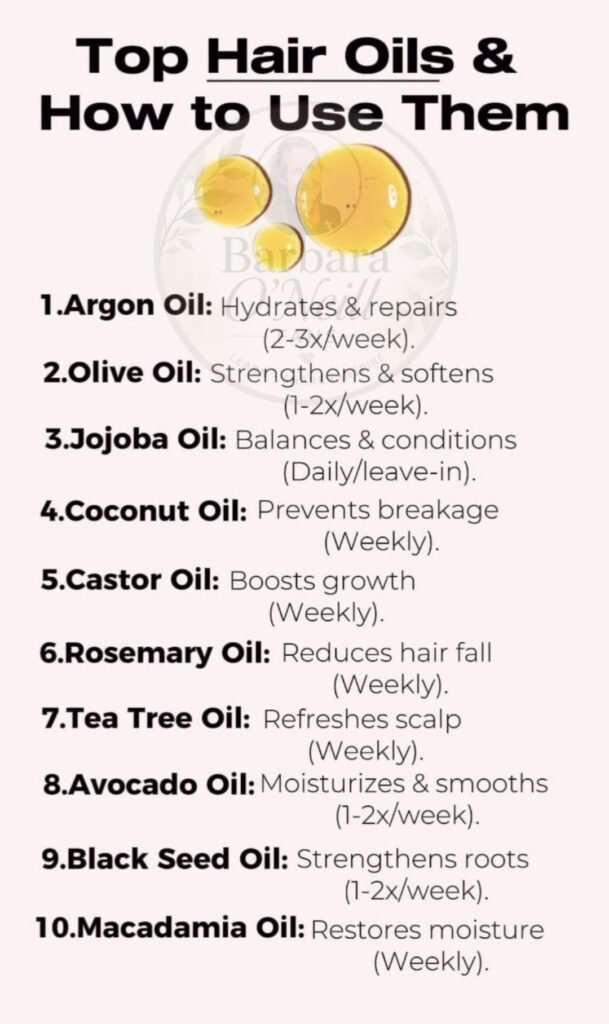
Here are 10 popular hair oils, what they may actually do, and how to use them safely.
1. Argan Oil
Argan oil is rich in fatty acids and other compounds that can help condition the hair and improve its feel and appearance.
Research has found that applying argan oil before oxidative treatment reduced protein loss from hair samples, suggesting a potential protective effect against certain types of damage.
Best for:
– Dry or rough hair
– Hair exposed to heat or chemical treatments
– Improving softness and shine
– Reducing the feeling of dryness
How to use it
Apply a small amount mainly to the mid-lengths and ends of the hair. It can be used as a pre-wash treatment or in a very small amount as a finishing oil.
Important: Evidence that argan oil directly stimulates hair growth is currently limited.
2. Olive Oil
Olive oil contains fatty acids and antioxidant compounds and can work as an emollient, helping hair feel softer and smoother.
It may be particularly useful for people with coarse or very dry hair.
Best for:
– Dry hair
– Coarse hair
– Improving softness
– Reducing the appearance of frizz
How to use it
Apply a small amount to the lengths and ends of the hair. Leave it on for a period of time before washing, especially if your hair becomes greasy easily.
Olive oil should be viewed primarily as a conditioning treatment rather than a proven hair-growth treatment.
3. Jojoba Oil
Jojoba oil is technically a liquid wax rather than a traditional vegetable oil. It is commonly used in cosmetic products because of its conditioning properties.
It can help make dry hair feel smoother without necessarily requiring a large amount.
Best for:
– Dry hair
– Dry-feeling scalp
– Smoothing the hair
– Reducing the appearance of frizz
How to use it
Use a small quantity on the lengths and ends. If applying it to the scalp, avoid excessive amounts and discontinue use if irritation or itching develops.
There is not strong clinical evidence that jojoba oil itself stimulates significant new hair growth.
4. Coconut Oil
Coconut oil is one of the better-studied natural oils for hair.
Research has shown that coconut oil can reduce protein loss from both damaged and undamaged hair, which may help protect the hair shaft from certain types of damage.
A systematic review also found clinical evidence supporting coconut oil for brittle hair, although evidence for promoting hair growth remains limited.
Best for:
– Brittle hair
– Dry hair
– Hair prone to breakage
– Pre-wash treatments
How to use it
Apply a small amount to the hair before washing. Focus on the lengths and ends, particularly if your hair is dry or damaged.
If coconut oil leaves your hair heavy or greasy, use less frequently or switch to a lighter product.
5. Castor Oil
Castor oil is one of the most popular oils on social media for hair growth.
However, the evidence doesn’t support the strong claim that castor oil directly makes hair grow faster. A systematic review found weaker evidence for improving hair quality and shine, but no strong evidence supporting castor oil for hair growth.
Best for:
– Conditioning
– Adding shine
– Dry-feeling hair
How to use it
Castor oil is extremely thick, so a small amount may be easier to use when mixed into a suitable hair-care product or lighter oil.
Avoid applying excessive amounts to the scalp, particularly if you are prone to irritation or buildup.
6. Rosemary Oil
Rosemary oil has attracted considerable attention because of research investigating its potential role in hair growth.
One randomized comparative trial involving people with androgenetic alopecia found that rosemary oil and 2% minoxidil both showed increased hair counts after six months, with no significant difference between the groups at that point. However, this was a relatively small study, so it should not be interpreted as proof that rosemary oil works for everyone.
More recent research continues to investigate rosemary-based oils, but larger and longer studies are still needed.
Best for:
– People interested in scalp-focused hair care
– Complementary hair-care routines
How to use it safely
Rosemary essential oil should not be applied undiluted directly to the scalp. Essential oils can irritate the skin.
If you are experiencing significant hair loss, it’s better to determine the cause rather than relying only on an oil.
7. Tea Tree Oil
Tea tree oil is commonly found in scalp and hair-care products because of its antimicrobial properties.
It may be useful in formulations designed for scalp cleansing, but that does not mean it is a proven treatment for hair loss.
Best for:
– Scalp-care products
– Oily-feeling scalp
– Hair-care routines focused on scalp cleanliness
Safety
Tea tree oil is an essential oil and can irritate the skin when used improperly. It should not be swallowed and should not be applied to the scalp in concentrated form.
A properly formulated commercial hair or scalp product is generally a safer option than experimenting with concentrated essential oils.
8. Avocado Oil
Avocado oil contains fatty acids and is commonly used in moisturizing hair products.
It can help dry hair feel softer and smoother and may be particularly useful for coarse or textured hair.
Best for:
– Dry hair
– Coarse hair
– Improving softness
– Reducing the appearance of dryness
How to use it
Apply a small amount to the lengths and ends or use it as part of a pre-wash conditioning treatment.
Because it is relatively rich, start with a small amount.
9. Black Seed Oil
Black seed oil, also called Nigella sativa oil, is traditionally used in several cultures for skin and hair care.
It contains various bioactive compounds and has attracted scientific interest, but evidence specifically demonstrating that applying black seed oil to the scalp reliably strengthens hair roots or produces significant hair growth is still limited.
Best for:
– Conditioning the hair
– Traditional scalp-care routines
– Dry-feeling hair
How to use it
Use a small amount as a pre-wash treatment or in a formulated hair product.
Stop using it if you develop itching, redness or irritation.
10. Macadamia Oil
Macadamia oil is rich in fatty acids and is commonly used in cosmetic products designed for dry or damaged hair.
It can help improve the hair’s softness and provide a smoother appearance.
Best for:
– Dry hair
– Frizzy hair
– Coarse hair
– Improving softness and shine
How to use it
Apply a small amount to the mid-lengths and ends. It can also be incorporated into a conditioning treatment.
Which Hair Oil Should You Choose?
There is no single “best” oil for every hair type.
Hair concern| Oils to consider
Dry hair| Coconut, argan, avocado, olive
Brittle or damaged hair| Coconut, argan
Frizz| Argan, jojoba, macadamia
Dry-feeling ends| Argan, avocado, jojoba
Scalp-focused routine| Rosemary-containing products
Shine| Argan, castor, jojoba
Hair protection| Coconut, argan
The evidence is strongest for conditioning and protecting the hair shaft, rather than for dramatically increasing hair growth.
How Often Should You Oil Your Hair?
The ideal frequency depends on your hair type and how your scalp responds.
For many people, once or twice a week is enough for a pre-wash oil treatment.
Fine or oily hair may require less oil, while very dry or coarse hair may tolerate richer treatments more often.
More oil does not necessarily mean better results.
A Simple Hair-Oiling Routine
Step 1: Choose one oil
Start with one oil rather than mixing several oils together. This makes it easier to determine what works for your hair.
Step 2: Use a small amount
Begin with a small quantity, particularly if your hair is fine or your scalp becomes oily easily.
Step 3: Focus on the hair
For conditioning, concentrate on the lengths and ends rather than saturating the scalp.
Step 4: Allow the oil to condition the hair
A pre-wash treatment can be left on for a reasonable period before washing.
Step 5: Wash thoroughly
Use your normal shampoo and conditioner to remove excess oil.
Can Hair Oils Stop Hair Loss?
This is where it’s important to distinguish hair breakage from hair loss.
Oils can make hair feel smoother and may help reduce certain types of dryness and damage. Coconut oil, for example, has evidence for reducing protein loss from hair.
But hair falling from the root can have many different causes, including genetics, hormonal changes, nutritional problems, illness, medications and scalp conditions.
Hair oil alone cannot address all of these causes.
Rosemary oil has some promising research, but the evidence remains limited compared with established medical approaches to hair loss.
Important Safety Tips
Before adding a new oil to your routine:
– Perform a small skin test if you’re prone to reactions.
– Stop using the product if you develop redness, burning or significant itching.
– Do not put essential oils directly into your eyes.
– Do not swallow essential oils.
– Avoid using large amounts of oil on an irritated or damaged scalp.
– Keep essential oils away from children and pets.
– If hair loss is sudden, severe or persistent, speak with a healthcare professional.
Final Thoughts
Hair oils can be useful additions to a simple hair-care routine, especially when the goal is to improve softness, shine, manageability and protection from dryness.
Among the oils discussed, coconut oil has particularly good evidence for reducing hair protein loss, while argan oil has some evidence for protecting hair from oxidative damage. Rosemary oil is promising for hair growth, but more research is needed. Castor oil, despite its popularity online, does not currently have strong evidence for stimulating hair growth.
The most important thing is to choose an oil based on your actual hair needs rather than assuming that a popular natural remedy will produce dramatic results.
Healthy-looking hair starts with gentle care, adequate nutrition and addressing the underlying cause of any persistent hair or scalp problem.
Disclaimer: This article is for educational purposes only and does not replace professional medical advice, diagnosis or treatment.