
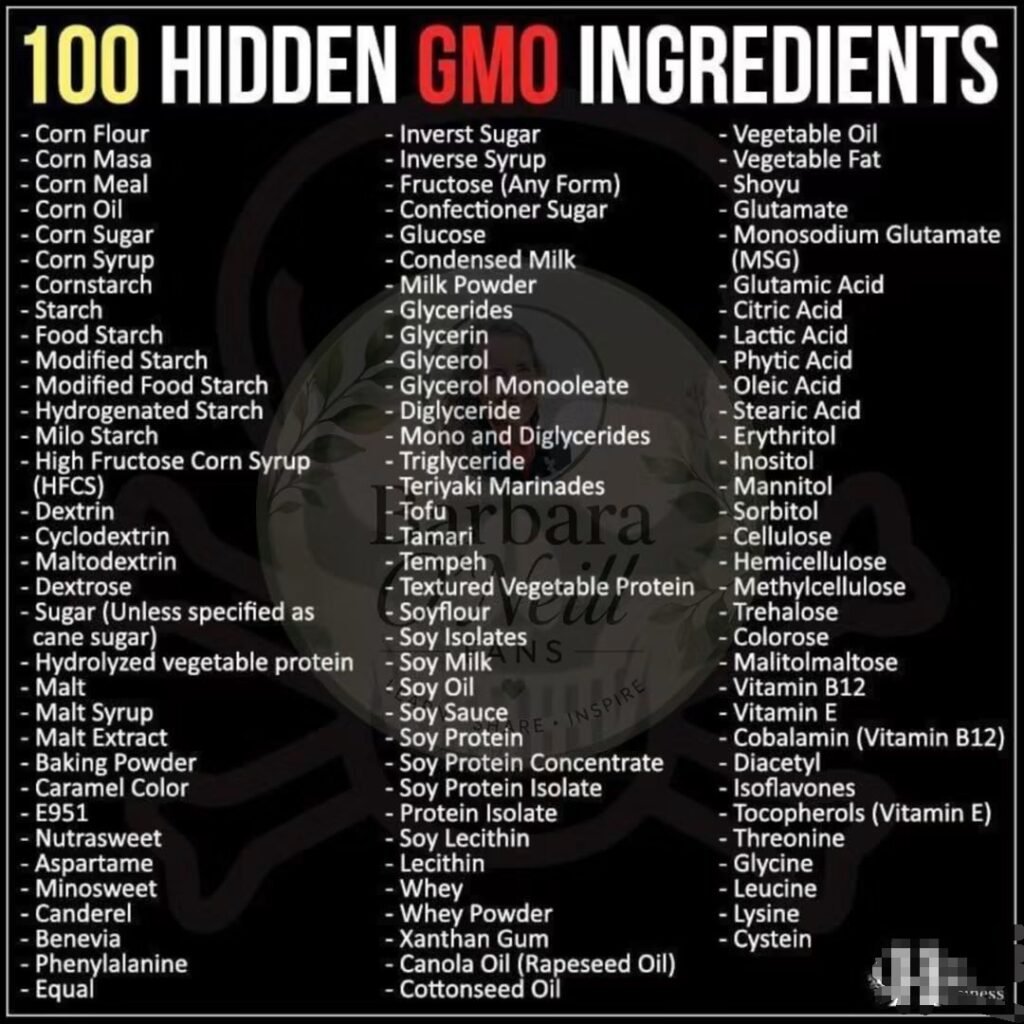
What the Viral List Gets Right and Wrong
A viral image circulating online claims to identify “100 hidden GMO ingredients” found in everyday foods. The list includes corn flour, corn syrup, maltodextrin, soy lecithin, canola oil, MSG, citric acid, vitamins, starches and many other ingredients.
The image raises a legitimate question: Can an ingredient on a food label tell us whether a product contains genetically modified material?
The answer is more complicated than the viral graphic suggests.
What does GMO mean?
GMO stands for genetically modified organism. In food production, genetic engineering can be used to give crops particular characteristics, such as resistance to certain insects, viruses or herbicides.
Common genetically engineered crops include corn, soybeans, canola, cotton and sugar beet, among others. The USDA maintains an official list of foods that are available in bioengineered forms.
However, the fact that an ingredient can come from a genetically engineered crop does not mean that every product containing that ingredient is GMO.
Why are ingredients such as corn syrup and soy lecithin on the list?
Several ingredients shown in the viral image can indeed be produced from crops that have genetically engineered varieties.
For example, corn-derived ingredients can include:
– Corn flour
– Corn starch
– Corn syrup
– Corn oil
– Dextrose
– Maltodextrin
– High-fructose corn syrup
Similarly, soy-derived ingredients can include:
– Soy lecithin
– Soy protein isolate
– Soy protein concentrate
– Soybean oil
– Soy flour
Campbell’s, for example, identifies corn, soy, canola and sugar-derived ingredients among ingredients that may be derived from genetically engineered crops, while emphasizing that they are not necessarily used in GMO form in every product.
This is an important distinction that the viral image does not make clear.
Does “maltodextrin” automatically mean GMO?
No.
Maltodextrin can be produced from corn, but the source may be genetically engineered or non-genetically engineered.
In fact, manufacturers can specifically use non-GMO corn maltodextrin. An example from the food industry describes maltodextrin made from non-GMO corn.
Therefore, seeing “maltodextrin” on an ingredient list does not prove that the product contains a GMO ingredient.
What about soy lecithin?
Soy lecithin is another ingredient frequently highlighted on lists like the one in the image.
Soybeans have genetically engineered varieties, and soy lecithin can therefore potentially be derived from genetically engineered soy. Some manufacturers, however, use non-GMO soy lecithin.
So, once again, the ingredient name alone does not establish its genetic origin.
MSG is not synonymous with GMO
The image also lists monosodium glutamate (MSG) among supposed hidden GMO ingredients.
MSG is a flavor enhancer made from glutamic acid. Its presence does not automatically mean that a food is genetically modified.
The same principle applies to ingredients such as citric acid, lactic acid, glycerin, tocopherols and various amino acids: their names do not by themselves prove that they originated from genetically engineered crops.
Are all 100 ingredients actually GMO?
No.
This is probably the biggest problem with the viral graphic.
The list mixes together:
1. Ingredients that may be derived from genetically engineered crops.
2. Ingredients that can also be produced from non-GMO sources.
3. Ordinary food ingredients that are not inherently genetically modified.
4. Chemical compounds that can have several different manufacturing sources.
Consequently, describing all of them as “100 hidden GMO ingredients” is misleading.
A more accurate description would be something like:
«“Ingredients that may be derived from crops or raw materials that have genetically engineered varieties.”»
That wording recognizes the difference between a possible source and a confirmed source.
Does GMO automatically mean unhealthy?
This is another area where online discussions often become confusing.
The World Health Organization explains that GM foods should be evaluated case by case, because different genetically modified organisms involve different genetic modifications. WHO also states that GM foods currently available on the international market have passed safety assessments and have not been shown to pose risks to human health in the populations where they have been approved.
That does not mean that every future genetically engineered food should automatically be considered safe. Rather, each product should undergo appropriate safety assessment.
How can consumers know whether a food is bioengineered?
In the United States, the USDA’s National Bioengineered Food Disclosure Standard establishes requirements for disclosure of foods that meet the federal definition of bioengineered food. Disclosures can appear as text, a symbol, a digital link or text-message instructions.
Importantly, the USDA also explains that a bioengineered-food disclosure is not a statement about whether the food is healthy or unhealthy. It is primarily a disclosure about the food’s bioengineering status.
The USDA definition also considers whether modified genetic material remains detectable. Highly refined ingredients may therefore be treated differently under the disclosure standard.
What should you look for on food labels?
If you want to reduce your exposure to genetically engineered ingredients, don’t assume that every ingredient on the viral list is GMO.
Instead, look for:
– USDA Organic certification when shopping in the United States.
– Non-GMO certification or credible non-GMO labeling.
– Specific manufacturer statements about ingredient sourcing.
– Bioengineered-food disclosures where applicable.
– The full ingredient list and country-specific labeling requirements.
The USDA notes that simply lacking a bioengineered disclosure does not automatically mean that a product can be considered non-GMO.
The bigger lesson
The viral image contains a kernel of truth: many common food ingredients can be produced from crops that have genetically engineered varieties, particularly corn, soy, canola and sugar beet.
But turning that information into a list of “100 hidden GMO ingredients” gives consumers the wrong impression.
An ingredient such as corn starch, maltodextrin or soy lecithin does not automatically tell you whether the source crop was genetically engineered.
The most useful approach is therefore not to fear every unfamiliar ingredient name, but to understand where an ingredient comes from, how it was produced and what labeling or certification applies to the finished food.
Bottom line
The viral list should not be treated as a definitive list of 100 GMO ingredients. It is better understood as a list of ingredients that may, depending on their source and production method, be associated with genetically engineered crops.
Reading labels carefully and checking reliable certification or manufacturer information is much more informative than assuming that every ingredient on the viral graphic is automatically GMO.