
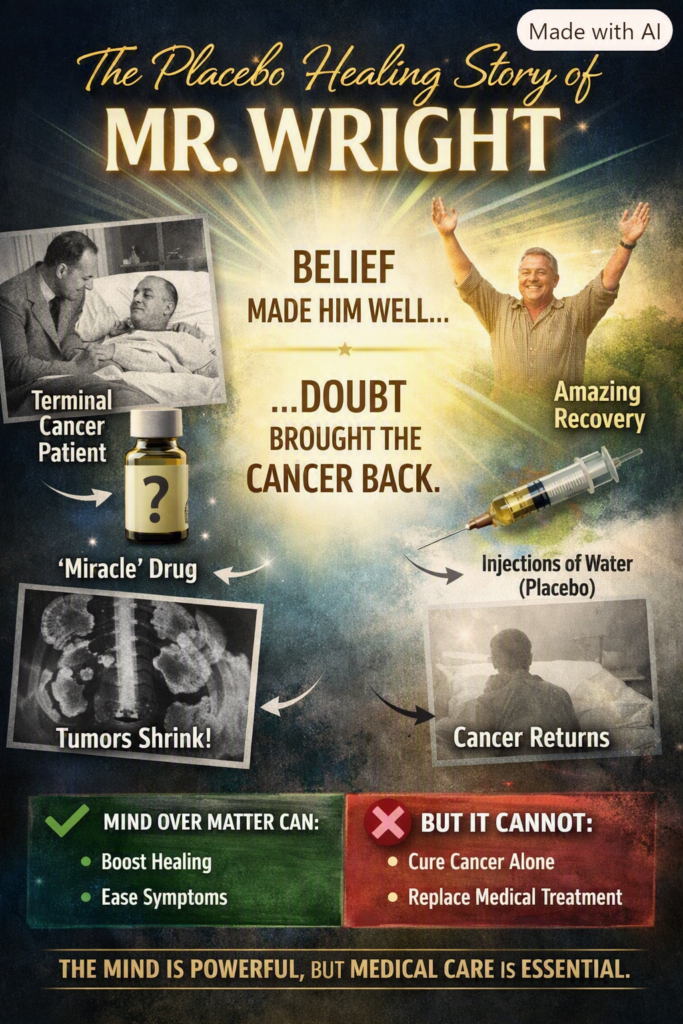
Mr. Wright’s story is one of the most famous examples of the placebo effect: his tumors shrank dramatically when he believed in a new cancer drug, but returned when he lost faith. It shows how powerful the mind can be in influencing the body — though it is not a substitute for medical treatment.
The Incredible Placebo Story of Mr. Wright
📖 Background
- In the 1950s, a patient known as Mr. Wright was diagnosed with advanced lymphosarcoma, a terminal cancer.
- He had large tumors in his neck, chest, and abdomen, and conventional treatments had failed.
💉 The “Miracle” Drug Krebiozen
- A new drug called Krebiozen was being tested.
- Mr. Wright begged his doctor for it, even though he was considered too ill.
- After his first injection, his tumors reportedly shrunk by half within days, and he was discharged from the hospital.
🔄 Relapse and Renewed Hope
- Later, reports showed Krebiozen was ineffective.
- Mr. Wright lost hope, and his cancer returned.
- His doctor then told him a “new, stronger batch” was available — but injected him with sterile water.
- Amazingly, Mr. Wright’s tumors disappeared again, and he regained strength.
⚠️ The Final Decline
- When the American Medical Association officially declared Krebiozen worthless, Mr. Wright lost all faith.
- His cancer returned aggressively, and he died within days.
🧠 What This Means
- This case illustrates the placebo effect: improvement caused by belief and expectation rather than the treatment itself.
- Placebos can influence:
- Pain perception
- Immune responses
- Hormone release
- Even physical symptoms like inflammation and mobility
🚨 Important Disclaimer
- While Mr. Wright’s story is extraordinary, it does not mean the mind alone can cure cancer or other serious diseases.
- The placebo effect can support healing and symptom relief, but it is not a replacement for evidence‑based medical care.
- Researchers continue to study how belief, expectation, and brain chemistry interact to affect health.
📌 Bottom Line
- Mr. Wright’s case shows the mind–body connection is real and powerful.
- Positive belief can enhance recovery, but medical treatment remains essential.
- The story is a reminder of how hope and mindset can influence health outcomes.