
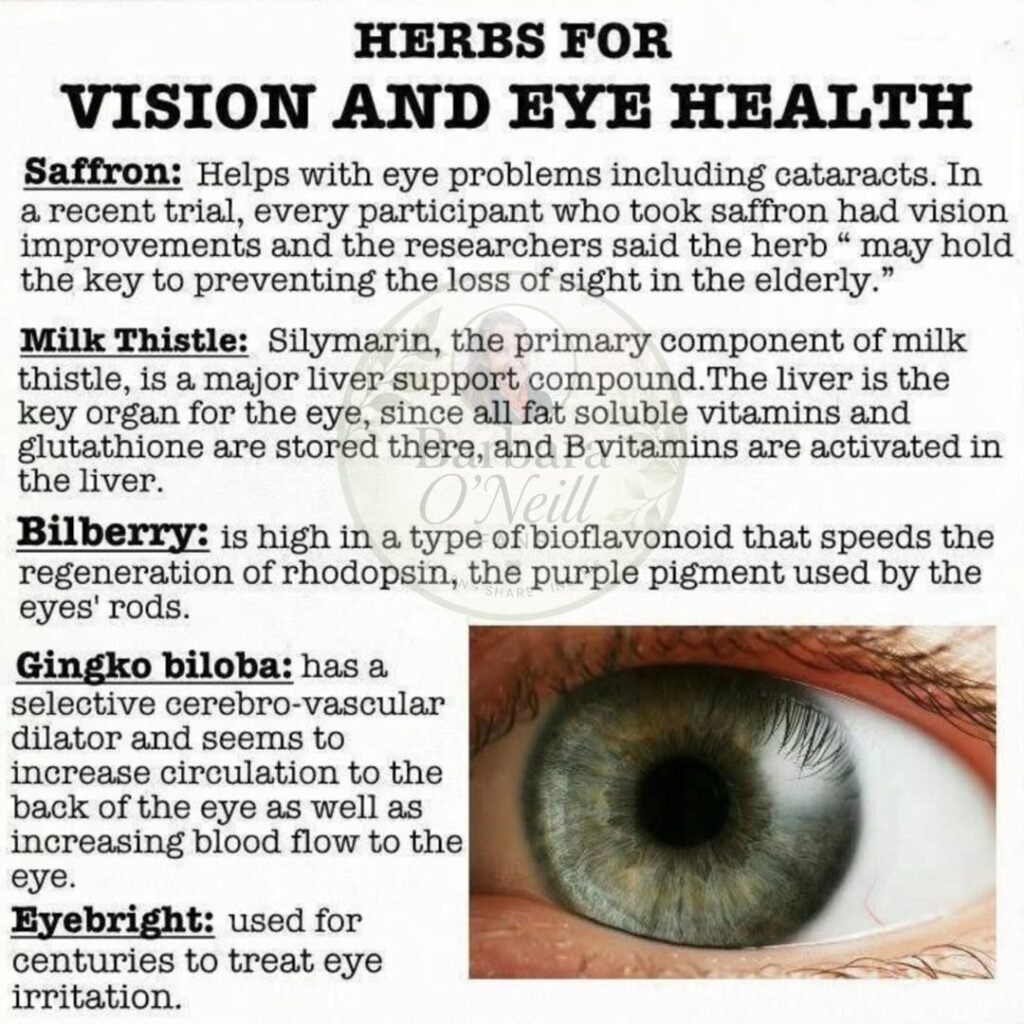
Herbs for Vision and Eye Health: What Science Really Says
Healthy vision depends on many factors, including age, genetics, nutrition, blood circulation, and overall health. Certain herbs and plant compounds have attracted scientific interest because of their antioxidant and anti-inflammatory properties. However, natural does not automatically mean effective or suitable for treating an eye disease.
Here is what current research suggests about several herbs commonly associated with eye health.
1. Saffron
Saffron is one of the most promising herbs on this list. It contains compounds such as crocin and crocetin, which have antioxidant properties and have been investigated for their effects on the retina.
Several clinical studies have examined saffron supplementation in people with age-related macular degeneration (AMD). A randomized clinical trial involving 100 adults with mild-to-moderate AMD found that 20 mg of saffron daily produced a modest improvement in visual function compared with placebo.
A later 12-month study also found improvements in some measures of retinal function, although visual acuity itself did not improve and actually declined slightly during the study, potentially because of cataract progression.
What this means: Saffron is promising for research into age-related retinal health, but it should not be presented as a proven treatment or cure for cataracts, AMD, or other eye diseases.
2. Bilberry
Bilberries contain anthocyanins, antioxidant compounds that have been studied for their possible effects on circulation and retinal function.
Bilberry has traditionally been associated with night vision and eye health, but claims that it can dramatically improve eyesight or regenerate the retina are not well established by clinical evidence.
What this means: Bilberries can be part of a healthy diet, but they should not replace medical treatment for vision problems.
3. Ginkgo Biloba
Ginkgo biloba has been investigated because of its possible effects on blood circulation and antioxidant activity. Researchers have particularly studied it in relation to glaucoma and other conditions involving the optic nerve.
However, evidence remains inconclusive. A 2025 systematic review of eight studies involving 428 participants found insufficient evidence that ginkgo biloba extract significantly improves eye pressure or visual-field measurements in glaucoma.
What this means: Ginkgo biloba should not be considered a proven treatment for glaucoma or a substitute for prescribed eye care.
4. Eyebright
Eyebright has been used traditionally for eye irritation and other minor eye complaints. Its traditional use is the reason it frequently appears in lists of herbs for eye health.
However, there is limited high-quality clinical evidence showing that eyebright can prevent or treat serious eye diseases.
Important: Putting homemade herbal preparations, teas, or extracts directly into the eyes can be unsafe and may cause irritation or infection. Eye products should only be used when they are specifically manufactured and approved for ophthalmic use.
5. Milk Thistle
Milk thistle contains silymarin, a group of plant compounds widely studied for their antioxidant properties and potential effects on liver health.
The liver plays important roles in metabolism and nutrient processing, but this does not mean that taking milk thistle directly improves eyesight. The claim that milk thistle supports vision simply because the liver stores certain vitamins or glutathione is not sufficient evidence that the herb improves eye health.
What this means: Milk thistle should not be promoted as an established treatment for vision loss or eye disease.
Other Nutrients Important for Eye Health
Eye health is not dependent on one particular herb. A balanced diet containing a variety of nutrients is generally more important.
Foods rich in leafy greens, colorful vegetables, fruits, fish, nuts, seeds, and other nutrient-dense foods can contribute to overall health and provide vitamins, minerals, carotenoids, and other compounds important for normal body function.
For people with specific eye conditions, ophthalmologists may recommend particular nutritional supplements based on the individual’s diagnosis and risk factors.
Can Herbs Restore Lost Vision?
This is where caution is especially important.
There is currently no herbal remedy that can reliably restore vision lost because of conditions such as advanced glaucoma, retinal detachment, severe optic-nerve damage, or other serious eye diseases.
Some plant compounds—including saffron—are being studied for their potential role in protecting or supporting retinal function. But promising research is not the same as a proven treatment. For example, the available saffron studies have mainly involved people with age-related macular degeneration and have shown relatively modest effects.
A Safer Approach to Eye Health
Instead of relying on a single herb, focus on habits that support overall eye health:
– Eat a varied, nutrient-rich diet.
– Have regular eye examinations, especially if you have vision changes or a family history of eye disease.
– Manage conditions such as diabetes and high blood pressure with appropriate medical care.
– Protect your eyes from excessive sunlight with suitable UV-protective eyewear.
– Avoid smoking.
– Do not put homemade herbal preparations directly into your eyes.
– Tell your doctor or pharmacist about herbal supplements you take, because some can interact with medicines.
The Bottom Line
Saffron, bilberry, ginkgo biloba, eyebright, and milk thistle are frequently promoted as herbs for better vision. However, the scientific evidence is very different from one herb to another.
Saffron currently has some of the more interesting clinical evidence, particularly in age-related macular degeneration, but further research is still needed.
For bilberry, eyebright, ginkgo biloba, and milk thistle, evidence is not strong enough to claim that these herbs can prevent or cure major eye diseases. In particular, recent evidence does not establish ginkgo biloba as an effective treatment for glaucoma.
Herbs may complement a healthy lifestyle, but they should not replace professional eye examinations or treatments prescribed for an eye condition.


I would love to know where to buy these herbs? My husband is starting to loose his eyesight due to Lebers disease. We are willing to try anything that would potentially help his vision
LHON is a rare, inherited mitochondrial genetic disease that specifically impairs Complex I of the mitochondrial respiratory chain in the retinal ganglion cells of the optic nerve. Because it is caused by a distinct cellular energy failure rather than standard eye strain, common herbal supplements will not reverse or halt the underlying condition.