
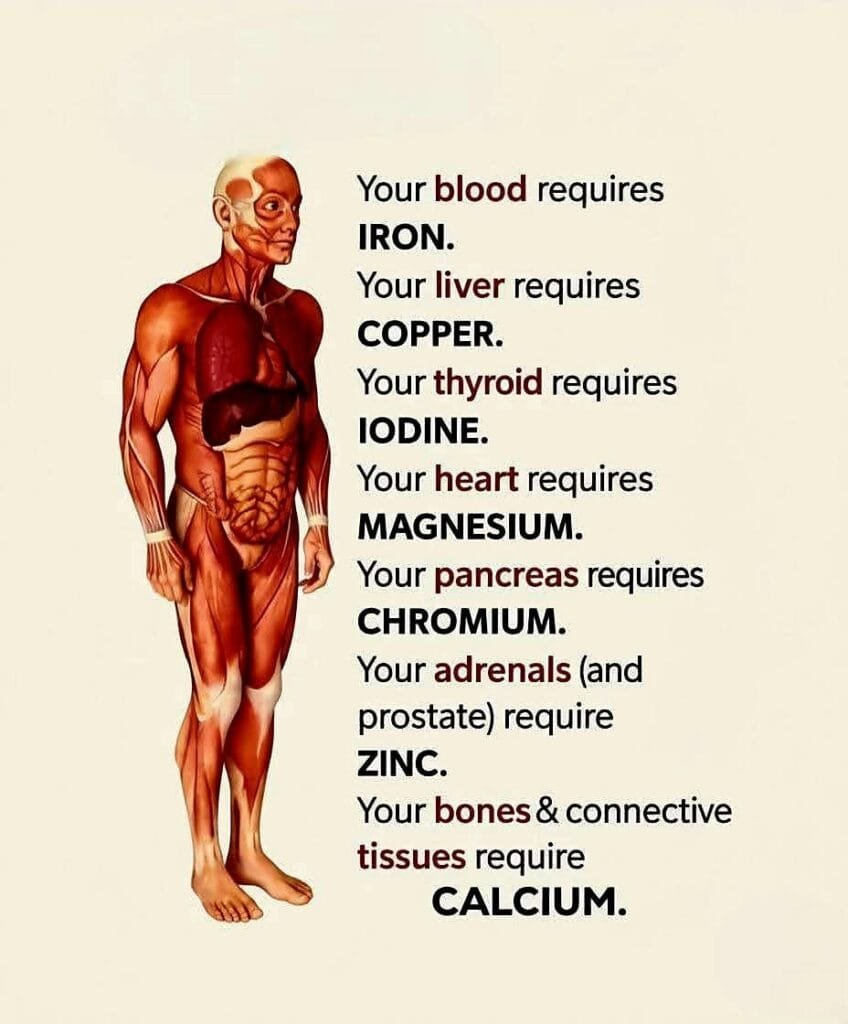
The image suggests that each organ “requires” one specific mineral. While minerals are essential, this presentation is overly simplified and partly misleading. In reality, every organ depends on many minerals working together, not just one.
Below is an accurate breakdown.
Iron & the Blood 🩸
✅ Mostly Accurate
Iron is essential for:
Hemoglobin (oxygen transport in red blood cells)
Energy metabolism
Immune function
⚠️ Important clarification:
Too much iron can be harmful
Iron deficiency and overload both cause serious problems
Iron is not only for blood—it affects the brain, muscles, and immune system
Copper & the Liver 🧠
⚠️ Partially Accurate
Copper is important for:
Iron metabolism
Antioxidant enzymes
Nervous system function
Connective tissue formation
❗ Reality:
The liver stores and regulates copper, but copper is required throughout the body
Excess copper damages the liver (e.g., Wilson’s disease)
Iodine & the Thyroid 🦋
✅ Accurate
Iodine is essential for:
Thyroid hormone production (T3 & T4)
Metabolism
Growth and brain development
⚠️ Note:
Both deficiency and excess iodine can disrupt thyroid function
Magnesium & the Heart ❤️
✅ Accurate but incomplete
Magnesium supports:
Heart rhythm
Blood pressure regulation
Muscle relaxation
Nerve signaling
❗ But also essential for:
Brain function
Blood sugar control
Bone structure
Over 300 enzymatic reactions
Chromium & the Pancreas 🍬
⚠️ Weak Evidence
Chromium may:
Assist insulin signaling
Slightly influence glucose metabolism
🚨 Important:
Evidence in humans is limited and inconsistent
Chromium is not essential for pancreas function in the way iodine is for thyroid
Supplementation rarely benefits healthy people
Zinc & the Adrenals / Prostate 🧬
⚠️ Partially Accurate
Zinc is vital for:
Immune function
Hormone synthesis
DNA repair
Wound healing
✔ Prostate does store zinc
❌ But “adrenals require zinc” is not exclusive or special
⚠️ Excess zinc:
Lowers copper
Weakens immunity
Calcium & Bones / Connective Tissue 🦴
⚠️ Incomplete
Calcium is essential for:
Bone and teeth structure
Muscle contraction
Nerve signaling
Blood clotting
❗ Bones also require:
Magnesium
Vitamin D
Vitamin K2
Phosphorus
Collagen (protein)
➡ Calcium alone does not build strong bones
The Big Problem With the Image ❌
The image implies:
“One mineral = one organ”
This is not how human biology works.
In reality:
Every organ needs multiple minerals
Minerals interact and balance each other
Deficiency or excess of one affects others
Example:
High calcium → lowers magnesium
Too much zinc → copper deficiency
Iron absorption depends on copper
Bottom Line ✅
✔ Minerals are essential
❌ No organ relies on only one mineral
❌ More is not better
❌ Supplementing blindly can cause harm
Best approach:
Eat a diverse, whole-food diet
Supplement only when deficient
Avoid “organ-specific mineral” marketing